In brief
A change in your basement’s relative humidity does not, by itself, tell you how much water was added or removed. The percentage depends on temperature as well as water vapor. Compare the temperature, location, and conditions beside each reading before deciding that a higher number means a new moisture source. National Weather Service explains relative humidity.
What changes when the air gets warmer?
Relative humidity describes the amount of water vapor present compared with saturation at the current temperature. If moisture content stays the same, warming the air lowers its relative humidity; cooling it raises the percentage. This conditional relationship does not establish what happened in your basement, where several conditions may change together.
That makes temperature part of a useful humidity record. A percentage without it leaves a question open. If your meter shows temperature, enter both values in the basement humidity log. Keep the meter in the same named location for comparisons.
Separate a physical example from a household observation
Imagine air with a constant dew point of 50°F. In this simplified calculation its water-vapor pressure stays unchanged while its temperature changes; no condensation or moisture exchange is included. These are calculated examples, not measurements from a house.
| Air temperature | Calculated RH, rounded | Assumed dew point |
|---|---|---|
| 60°F | 69% | 50°F |
| 70°F | 49% | 50°F |
| 80°F | 35% | 50°F |
The percentage falls from about 69% to 35% without a dehumidifier removing water in the calculation. Warming can therefore make an RH display fall without demonstrating that wet materials have dried. A real basement can also gain or lose moisture, so the table cannot establish what caused a particular change.
How these example values were calculated
Convert °F to °C using (°F − 32) × 5 ÷ 9. The National Weather Service vapor-pressure equations give es(T) = 6.11 × 107.5T/(237.3 + T) hPa and RH = 100 × e/es. Here e is held at es(50°F); temperature inside the equation is in °C. RH values are rounded to whole percentage points. The approximation illustrates the relationship; it does not improve a meter’s accuracy.
When reviewing your own humidity log, compare temperature and conditions beside RH. If the percentage fell but the air became warmer, retain that fact before attributing the whole change to moisture removal.
Read a sequence with consistent context
Start with the same location and a repeatable observation routine. Record the date, time, relative humidity, and temperature. Add a short note when you change a setting, move the meter, open an outside window, or notice water. Use “not recorded” when a detail is missing rather than filling it from memory.
When reviewing the sequence, compare entries from the same position first. Then look at the temperature and notes. If a change coincides with something you did, label it an association. Repeating observations may help you ask a better question, but a room log does not identify a hidden moisture source.
For a claimed improvement, specify the observation: for example, “the percentage at shelf A was lower at the next recorded check.” Avoid turning that sentence into “the wall is dry” or “the leak is fixed” without evidence about the wall or leak.
Use dew point when comparing different air conditions
Dew point is the temperature to which air must cool to reach saturation at its current moisture content. It adds useful moisture context when temperatures differ. Our outdoor and indoor comparison guide explains how to keep the source, time, and units beside it. A weather report’s dew point is still a reading for its stated location, not a measurement of your basement.
Keep visible water on its own action list
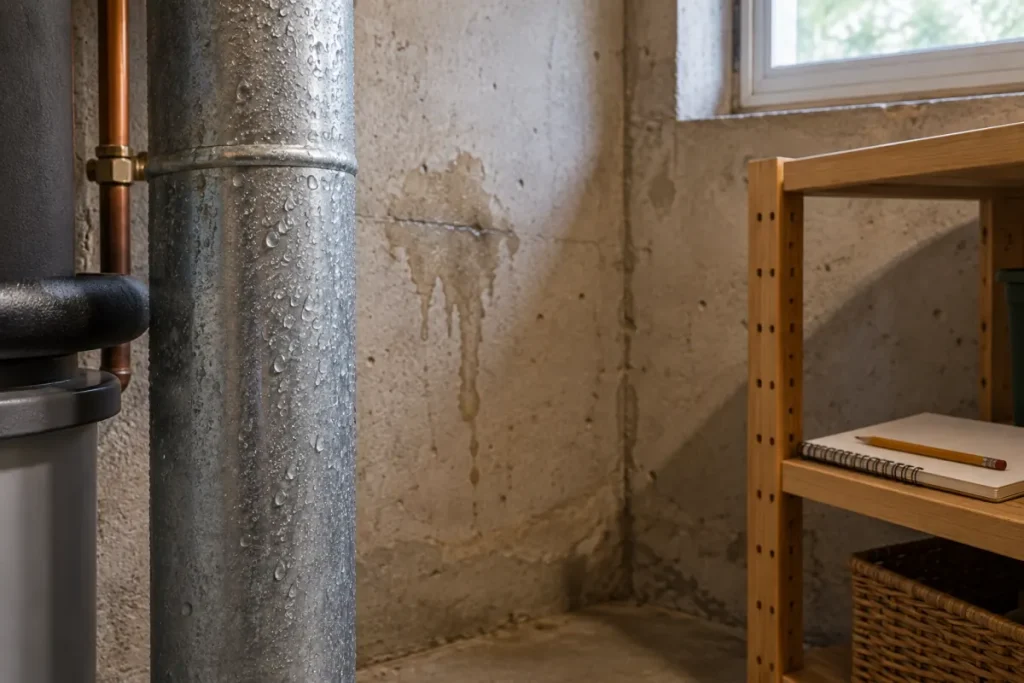
A falling percentage is not a reason to ignore water entering the building. EPA’s moisture-control guidance distinguishes leaks and seepage from condensation and emphasizes addressing water sources. Use our wet-surface observation guide to describe what you see; do not wait for a humidity trend to resolve an active leak.
The practical habit is simple: record the percentage with temperature, compare like locations, and describe what changed. That produces a more useful account than treating each new percentage as a verdict on the whole basement.