In brief
Compare indoor and outdoor dew points, not relative-humidity percentages alone, to judge which air contains less moisture. A lower dew point indicates drier air under comparable pressure conditions. Outdoor air at 80% RH can contain less moisture than basement air at 60% RH if it is colder. Keep temperature, observation time, and source beside each reading before deciding what the comparison means for your basement.
Why the lower percentage can be misleading
NOAA’s humidity explanation shows why relative humidity depends on temperature. With unchanged moisture content, warmer air has a lower relative humidity than cooler air. Dew point adds information about moisture: a higher dew point indicates more water vapor in the air under comparable pressure conditions.
For a basement comparison, the important question is what the available figures actually describe. “Outside is 50%” and “inside is 60%” omit temperature, time, and location. Those percentages alone do not establish that opening the window would remove moisture.
Build a paired record before interpreting it
Use two clearly labeled columns in your notes. One is the indoor observation; the other is the outdoor source. Keep the original units visible and use the same temperature scale when comparing dew points. Do not turn a missing value into zero.
| Field | Indoor entry | Outdoor entry |
|---|---|---|
| Source and location | Meter model and named basement position | Weather station or meter position |
| Time | Time of your reading | Observation time, not just app refresh time |
| Temperature and RH | Values shown by the meter | Values from the same outdoor observation |
| Dew point, if available | Reported or calculated value with its source | Reported value with the station or provider |
| Conditions | Windows, appliance operation, and visible water | Anything relevant to the observation’s representativeness |
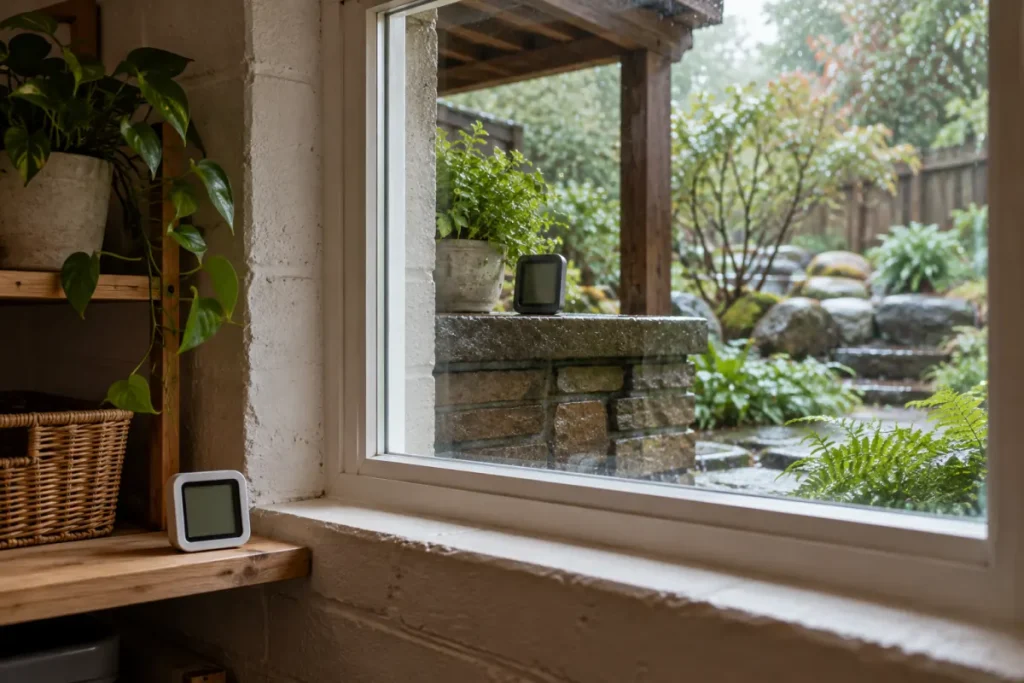
This table is an editorial recording aid. It does not make readings from different instruments equally accurate. If you place a meter outdoors, first check that the manufacturer allows that exposure and specifies a suitable position. A device intended for dry indoor use should not be assumed to tolerate rain or outdoor conditions.
Use dew point as moisture context
Compare dew points from observations taken at similar times, keeping their sources and units. The following pairs show why selecting the lower RH percentage can give the wrong moisture comparison. All values are hypothetical; dew points are calculated and rounded, not observed weather.
| Example | Temperature / RH | Calculated dew point |
|---|---|---|
| Basement, both comparisons | 68°F / 60% | About 54°F |
| Warmer outdoor air | 80°F / 50% | About 60°F |
| Colder outdoor air | 40°F / 80% | About 34°F |
In the warmer example, outdoors has the lower RH but the higher dew point: calling that air drier would reverse the moisture comparison. In the colder example, outdoors has the higher RH but the lower dew point. A high outdoor percentage by itself does not establish a high outdoor moisture content.
We calculated these examples with the NWS vapor-pressure relationship and its dew-point calculation, converting temperatures to °C first. Rounding and instrument uncertainty limit precision. For your own record, retain a device- or provider-reported dew point where available; otherwise mark its calculation and source.
This comparison answers a moisture question. It does not prescribe opening a window or evaluate outdoor air quality, security, required ventilation, or the temperature of basement surfaces. Keep those decisions separate.
What the indoor and outdoor dew points tell you
| Outdoor dew point compared with indoors | What it suggests | What to do with the observation |
|---|---|---|
| Clearly lower | The outdoor air contains less moisture under comparable pressure conditions. | Record the difference. Also assess outdoor air quality, weather, building ventilation needs, and security before opening a window. |
| Similar, or within the readings’ uncertainty | The measurements do not establish a useful moisture difference. | Check units, observation times, and instrument specifications rather than treating a small difference as decisive. |
| Clearly higher | The outdoor air contains more moisture, even if its RH percentage is lower. | Do not interpret the lower outdoor RH as evidence that bringing in that air will dry the basement. |
This is a reading guide, not a fixed window-opening rule. The dew-point comparison does not determine how much air will enter, how room conditions will change, or whether ventilation is suitable for the building.
Should you open basement windows when it is humid outside?
A high outdoor RH percentage alone cannot answer that question. In the cold-air example above, the outdoor dew point is lower despite 80% RH; in the warm-air example it is higher despite 50% RH. Use the paired dew points as moisture context, then consider outdoor pollutants, security, weather exposure, required ventilation, and the temperature of basement surfaces. Avoid a permanent “always open” or “always closed” rule based on one comparison.
If you make a suitable, safe change to the room, note the action and the subsequent observations. Keep the indoor meter at its established monitoring position. Use the humidity log to preserve the sequence rather than combining today’s outdoor screenshot with yesterday’s basement reading.
Choose the next useful observation
If temperature is missing, get a paired temperature and RH reading. If location or time is unclear, resolve that before comparing. If visible water is the concern, document the water separately with our surface-observation guide. For changes within the basement, our temperature and humidity guide explains why a lower percentage alone cannot prove drying.