In brief
You cannot decide whether outdoor air is drier than basement air by comparing the relative-humidity percentages alone when their temperatures differ. Keep temperature and, when available, dew point with each reading. A weather app and a room meter also represent different places, so write down their sources before treating them as a matched comparison.
Why the lower percentage can be misleading
NOAA’s humidity explanation shows why relative humidity depends on temperature. With unchanged moisture content, warmer air has a lower relative humidity than cooler air. Dew point adds information about moisture: a higher dew point indicates more water vapor in the air under comparable pressure conditions.
For a basement comparison, the important question is what the available figures actually describe. “Outside is 50%” and “inside is 60%” omit temperature, time, and location. Those percentages alone do not establish that opening the window would remove moisture.
Build a paired record before interpreting it
Use two clearly labeled columns in your notes. One is the indoor observation; the other is the outdoor source. Keep the original units visible and use the same temperature scale when comparing dew points. Do not turn a missing value into zero.
| Field | Indoor entry | Outdoor entry |
|---|---|---|
| Source and location | Meter model and named basement position | Weather station or meter position |
| Time | Time of your reading | Observation time, not just app refresh time |
| Temperature and RH | Values shown by the meter | Values from the same outdoor observation |
| Dew point, if available | Reported or calculated value with its source | Reported value with the station or provider |
| Conditions | Windows, appliance operation, and visible water | Anything relevant to the observation’s representativeness |
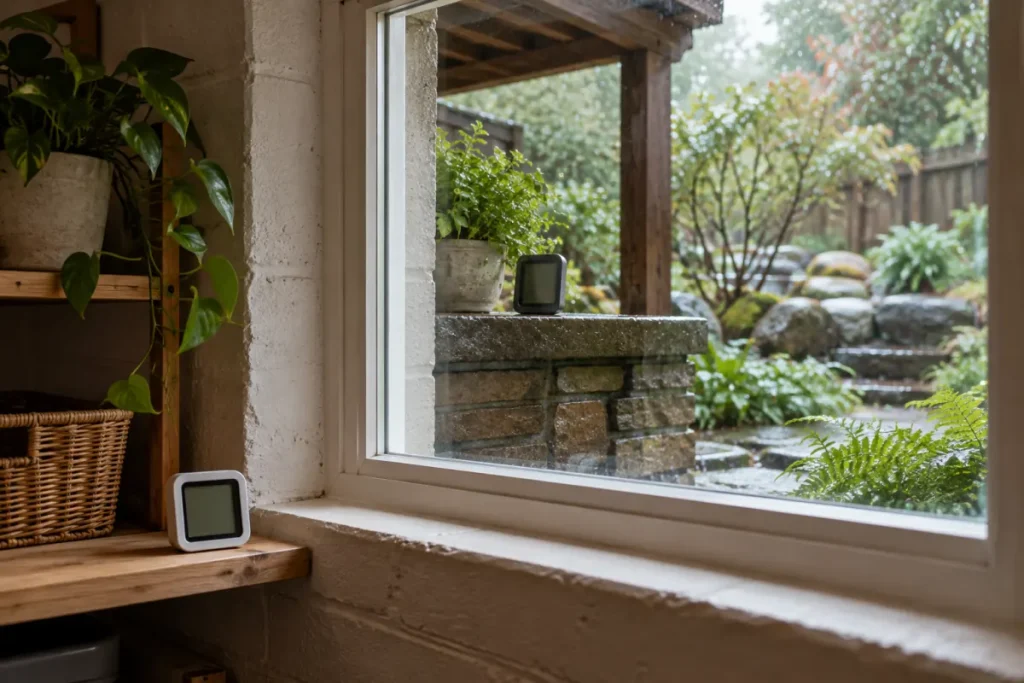
This table is an editorial recording aid. It does not make readings from different instruments equally accurate. If you place a meter outdoors, first check that the manufacturer allows that exposure and specifies a suitable position. A device intended for dry indoor use should not be assumed to tolerate rain or outdoor conditions.
Use dew point as moisture context
The National Weather Service defines dew point as the temperature at which cooling air becomes saturated. When the outdoor dew point is higher than the indoor dew point, that is evidence against calling the outdoor air “drier” just because its relative humidity is lower. Keep measurement limitations and the times of the observations in mind.
Illustrative comparison only: suppose two sources report dew points of 45°F and 60°F. The source reporting 60°F describes air with more moisture under comparable pressure conditions. These are hypothetical values, not readings from a house or recommended thresholds for opening windows.
If your indoor meter reports only temperature and RH, record those values. Leave dew point marked as unavailable unless you have a documented calculation or a device that provides it. This guide does not calculate it or attach a precise condensation prediction to a pair of screenshots.
A comparison does not settle the ventilation decision
Deciding whether and how to ventilate also needs the building’s requirements and current conditions. A paired humidity record does not check outdoor pollutants, security, weather exposure, required ventilation, or the temperatures of basement surfaces. Avoid a permanent “always open” or “always closed” rule based on a single comparison.
If you make a suitable, safe change to the room, note the action and the subsequent observations. Keep the indoor meter at its established monitoring position. Use the humidity log to preserve the sequence rather than combining today’s outdoor screenshot with yesterday’s basement reading.
Choose the next useful observation
If temperature is missing, get a paired temperature and RH reading. If location or time is unclear, resolve that before comparing. If visible water is the concern, document the water separately with our surface-observation guide. For changes within the basement, our temperature and humidity guide explains why a lower percentage alone cannot prove drying.