In brief
A change in your basement’s relative humidity does not, by itself, tell you how much water was added or removed. The percentage depends on temperature as well as water vapor. Compare the temperature, location, and conditions beside each reading before deciding that a higher number means a new moisture source. NOAA explains the temperature relationship.
What changes when the air gets warmer?
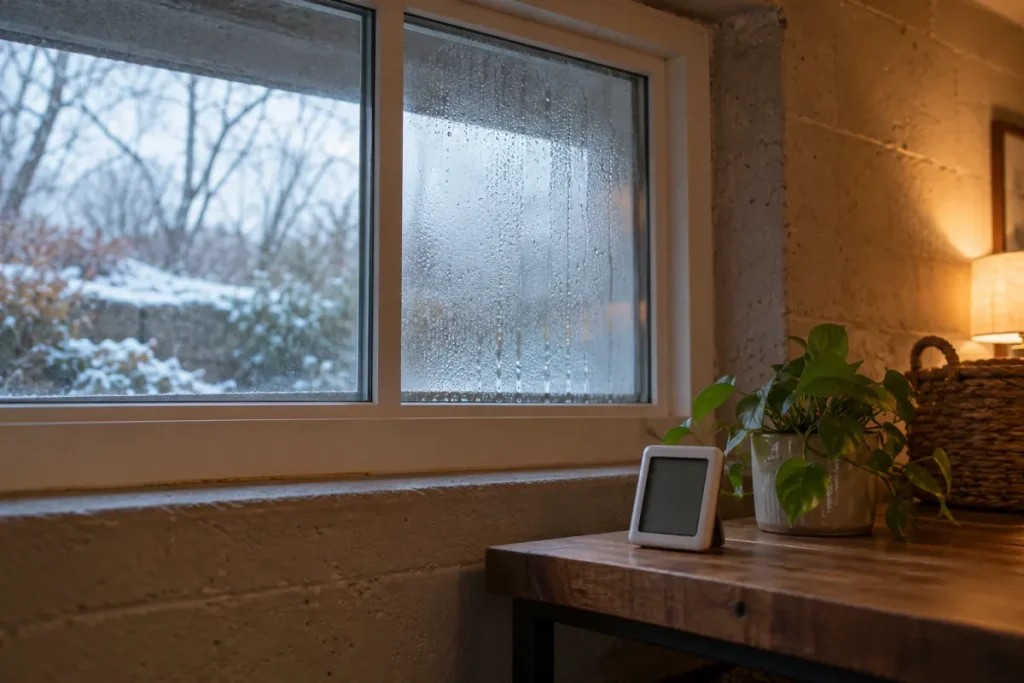
Relative humidity describes the amount of water vapor present compared with saturation at the current temperature. If moisture content stays the same, warming the air lowers its relative humidity; cooling it raises the percentage. This conditional relationship does not establish what happened in your basement, where several conditions may change together.
That makes temperature part of a useful humidity record. A percentage without it leaves a question open. If your meter shows temperature, enter both values in the basement humidity log. Keep the meter in the same named location for comparisons.
Separate a physical example from a household observation
Here is a qualitative illustration, not a measurement or a prediction for your home. Imagine a sample of air whose moisture content stays unchanged, with no condensation. If that sample becomes warmer, its relative humidity falls. No water had to be extracted for that change to occur. Reversing the temperature change raises the percentage under the same assumptions.
A real pair of room readings cannot prove those assumptions. A running appliance, a moved sensor, outdoor air, or wet materials may be part of the observation. Write down what you know and leave the remaining explanation open. The following record prompts are our editorial aid, not a diagnostic test.
| Recorded change | Question to investigate | Useful companion record |
|---|---|---|
| The temperature and percentage both changed | What other conditions changed between readings? | Meter position, time, appliance setting, and room notes |
| The percentage fell after a setting change | Was there water collection, and were the readings comparable? | Drainage observations and temperature at both times |
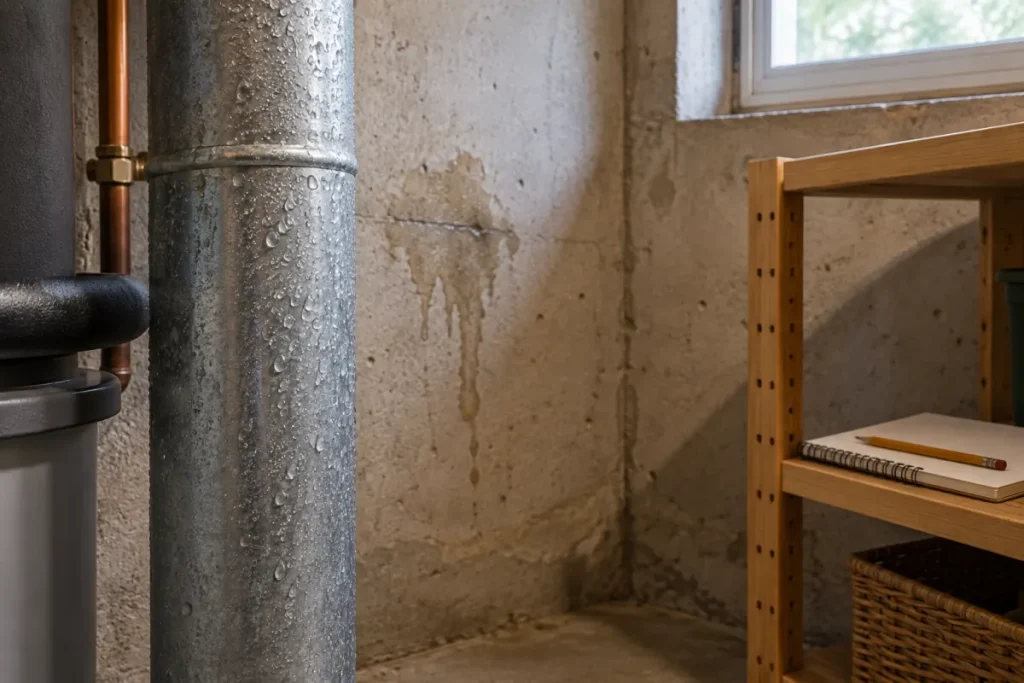
| A wet patch appeared | Where is the water, and what was happening when it appeared? | A dated location description and photographs, if safe |
Read a sequence with consistent context
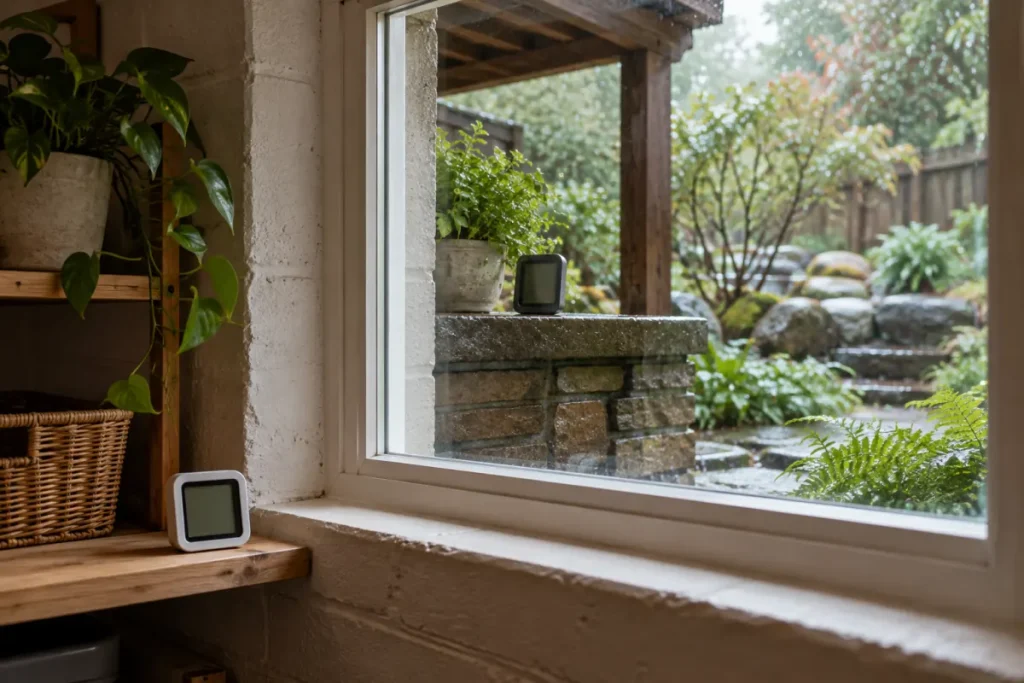
Start with the same location and a repeatable observation routine. Record the date, time, relative humidity, and temperature. Add a short note when you change a setting, move the meter, open an outside window, or notice water. Use “not recorded” when a detail is missing rather than filling it from memory.
When reviewing the sequence, compare entries from the same position first. Then look at the temperature and notes. If a change coincides with something you did, label it an association. Repeating observations may help you ask a better question, but a room log does not identify a hidden moisture source.
For a claimed improvement, specify the observation: for example, “the percentage at shelf A was lower at the next recorded check.” Avoid turning that sentence into “the wall is dry” or “the leak is fixed” without evidence about the wall or leak.
Use dew point when comparing different air conditions
Dew point is the temperature to which air must cool to reach saturation at its current moisture content. It adds useful moisture context when temperatures differ. Our outdoor and indoor comparison guide explains how to keep the source, time, and units beside it. A weather report’s dew point is still a reading for its stated location, not a measurement of your basement.
Keep visible water on its own action list
A falling percentage is not a reason to ignore water entering the building. EPA’s moisture-control guidance distinguishes leaks and seepage from condensation and emphasizes addressing water sources. Use our wet-surface observation guide to describe what you see; do not wait for a humidity trend to resolve an active leak.
The practical habit is simple: record the percentage with temperature, compare like locations, and describe what changed. That produces a more useful account than treating each new percentage as a verdict on the whole basement.