In brief
A dehumidifier’s pump-lift specification and the length of its drain hose answer different questions. Record the rise in the route, the full tubing path, and the manufacturer’s restrictions separately. A destination that appears close enough on the floor plan may still need a route the appliance does not support.
Still choosing a drainage method? Compare gravity drainage and a pump before checking a pump’s lift.
Three measurements to keep separate
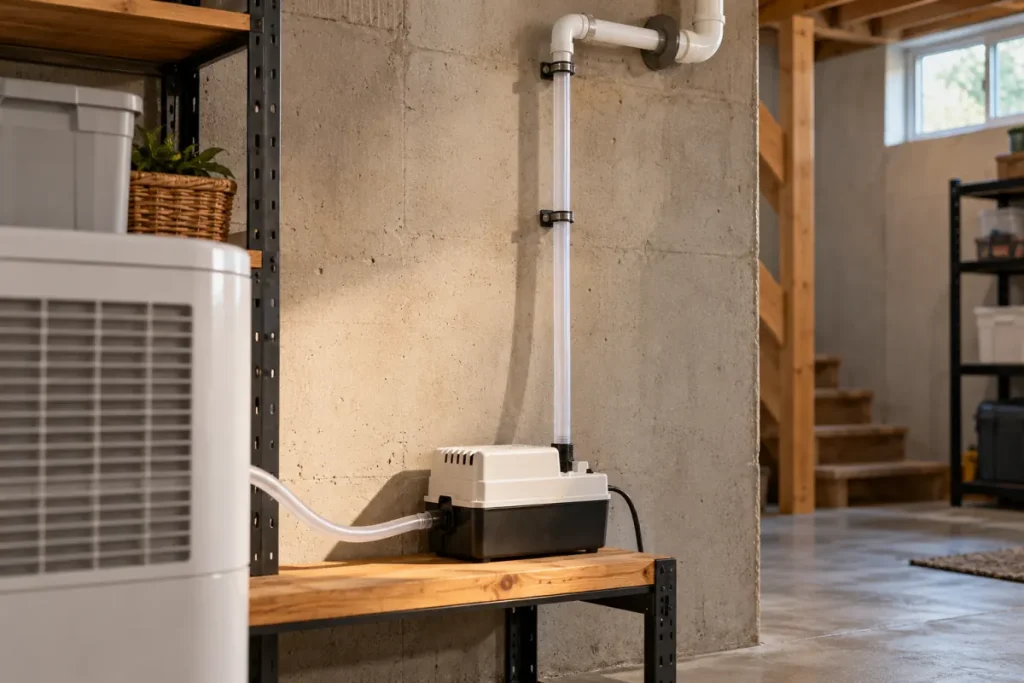
Vertical rise describes how far the water must move upward. Route length describes the full tubing path, including horizontal sections and turns. Hose requirements specify the tubing and connections that the manufacturer permits. A measurement for one of these does not establish compatibility with the others.
GE’s drainage overview, for the equipment it describes, gives a vertical pumping limit and also says not to extend the supplied tubing. Treat them as separate restrictions. This is a manufacturer example, not a universal pump specification.
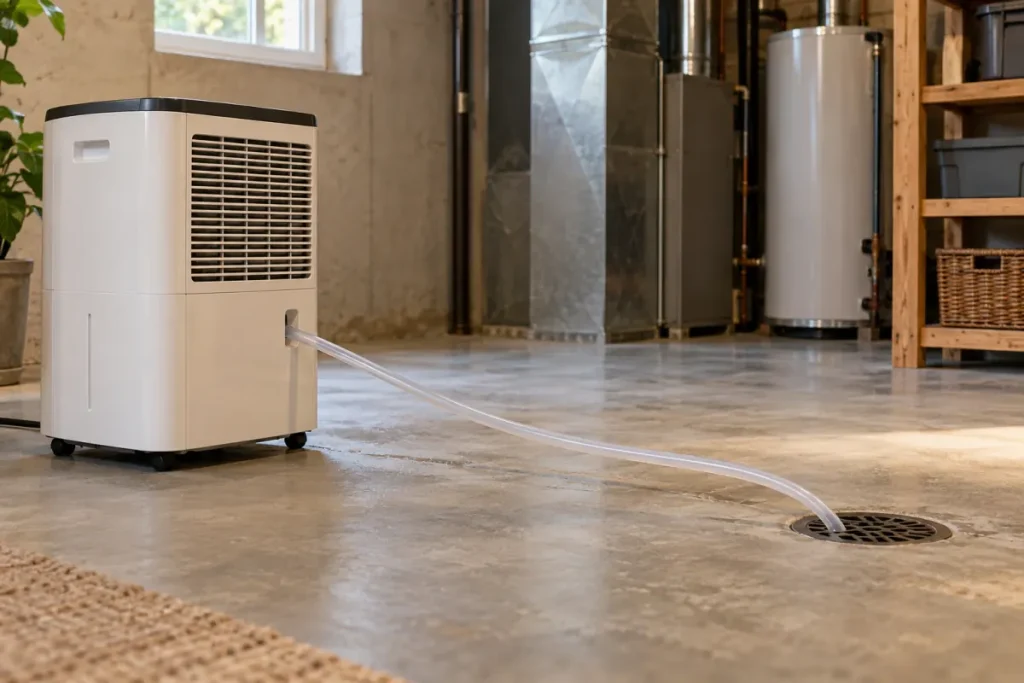
For a downhill route on a model that supports gravity drainage, check the gravity-drain hose and fitting before buying tubing.
Read the exact manual before planning a route
Find the model number on the appliance or proposed purchase. Locate its pump section, installation diagrams, hose instructions, and operating conditions. Save the manual reference and page numbers in your plan. Product titles and comparison cards may leave out conditions that matter.
For a concrete example, the GE manual 49-5000545 Rev. 4, linked from the APHL50LB owner page, lists a 16-foot maximum lift in its pump section. That figure belongs to the covered equipment and that manual. It is not evidence that another model, a longer hose, or every route under 16 feet will work.
Use the official model support page to see the manual’s provenance. This reference is an example of reading a specification; we have not tested or recommended that product.
Sketch the whole route
Mark the outlet, upward sections, full hose path and destination. These hypothetical routes show why checking lift alone can miss a documented restriction.
| Document | Proposed route | Decision |
|---|---|---|
| GE APHL50 manual, 49-5000545 Rev. 4, page 8 | 17 feet of upward lift | Exceeds its 16-foot lift limit. Reducing horizontal distance cannot remove that mismatch; the manual also requires the supplied pump hose. |
| Frigidaire FHDP5033Y1 guide, July 2025, page 18 | 18-foot straight horizontal run, without a rise | Exceeds the described 5 m (16.4-foot) maximum distance even with no lift. The guide gives a distance-and-rise restriction, not an extra horizontal allowance. |
Keep unresolved requirements visible
Choose a suitable closer or lower destination, or equipment documented for the required route. Do not add separate distance and lift figures into a larger allowance, or transfer one model’s limit to another. For bends, several rises or an unclear measurement reference, obtain the manufacturer’s interpretation before treating the route as supported.
Sources checked November 6, 2026. This is documentary analysis, not a pump test. Our pump-route and support worksheet holds the sketch and unresolved questions; it does not calculate compatibility.
Observe the supported setup after installation
Follow the owner instructions for connections, activation, and checks. Use our pump-start observation guide to record what the controls and drainage actually do. Keep the setup under observation during the first permitted cycle; a plan alone is not proof that the hose is secure or water reaches the intended destination.
If a safe, supported downhill destination exists, review the bucket, gravity, and pump comparison. The useful choice is the method that fits the room, the exact equipment, and a suitable destination—not a pump chosen just because the feature appears on the box.