In brief
A dehumidifier pump that is not running immediately is not automatically faulty. Check the exact unit’s activation instructions, required bucket position, collection stage, and supported hose route. Record what the appliance actually shows before attempting a correction or asking for support.
Confirm that the unit supports pump drainage
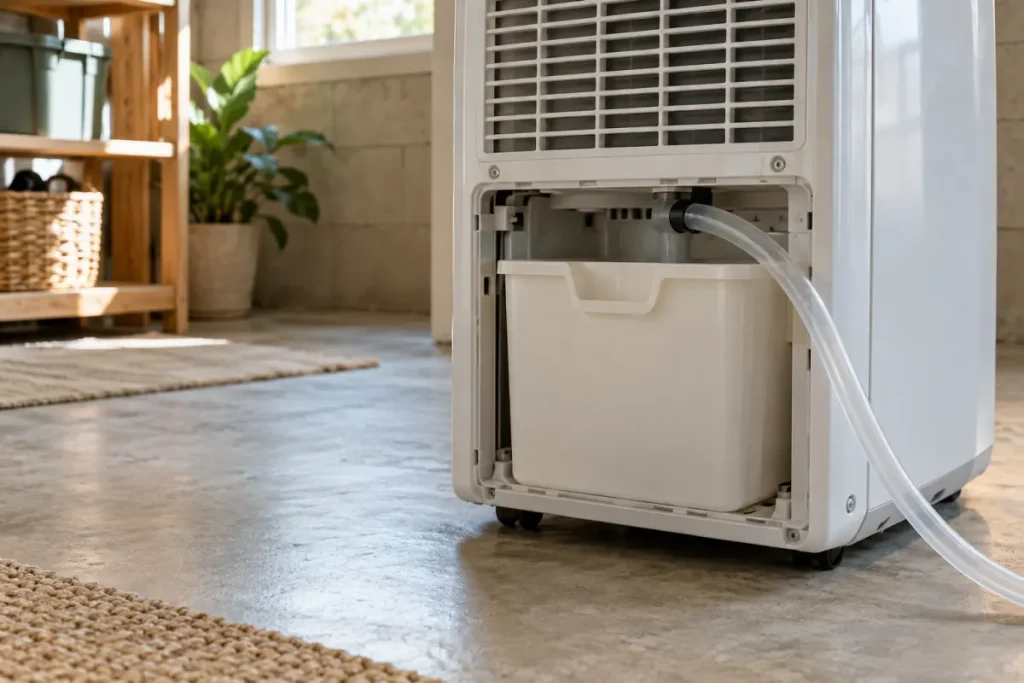
Find the model number and the manufacturer’s drainage section. Identify the pump connection against the diagram and check the specified hose. A hose connected to a gravity port does not establish that the pump is connected correctly. If your appliance has no internal pump, this guide does not turn it into one.
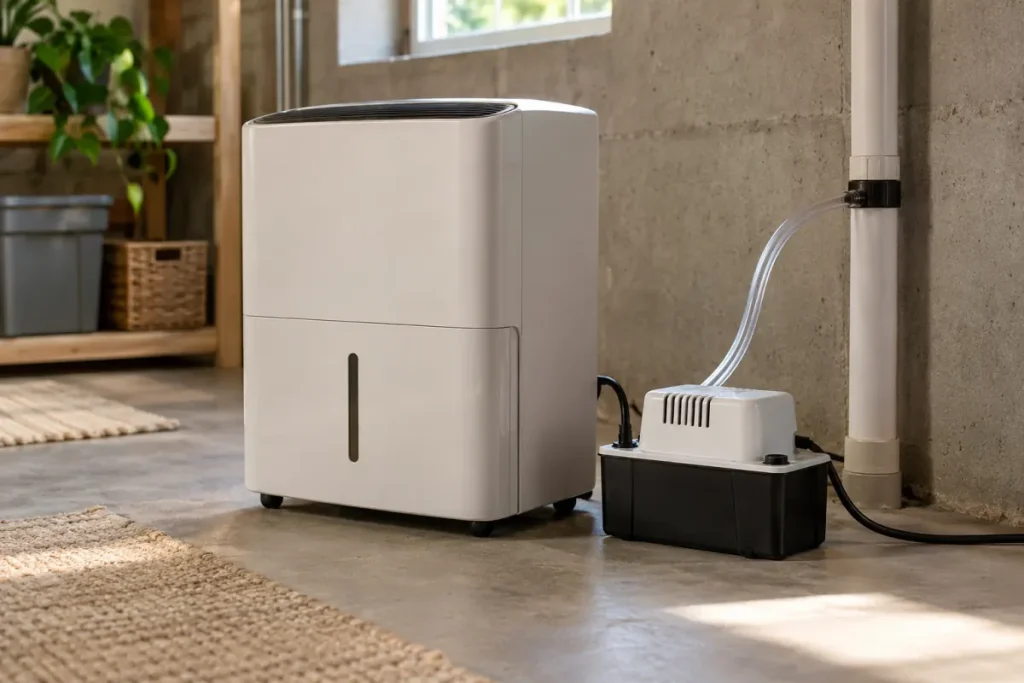
For method selection, see our drainage comparison. If you have a separate external pump, use its own instructions as well as the dehumidifier’s supported connection; this article does not provide an external-pump installation procedure.
Distinguish activation from the later pump cycle
GE’s pump-support page describes units that need an enabled pump, an installed bucket, and a full bucket before pumping begins. That is one manufacturer’s explanation, not a universal trigger for every model.
The GE manual 49-5000545 Rev. 4 also specifies an empty bucket before putting the covered unit into pump mode. Keep setup instructions and later cycle conditions separate. If your model’s documents leave the sequence unclear, ask its support team rather than manually filling the bucket to force a test.
Write down whether the pump is selected, whether its indicator is on, and whether a later discharge cycle has actually been observed. Do not infer a pumping cycle from a button press or fan sound alone.
Check the supported tubing route
Record the hose specified by the manual, the total path, the upward sections, and the discharge destination. Look at accessible tubing for damage, compression, or sharp bends, following the instructions for stopping the unit before handling connections. Do not pull out a connected hose while the pump is running.
The pump-lift guide explains why vertical rise and hose length need separate entries. A route that meets one advertised figure may still fail another installation condition. Use the blank route and support worksheet to make the unresolved details visible.
Record a useful sequence
| Stage | What to record | What to avoid assuming |
|---|---|---|
| Before activation | Model, instructions, bucket state, and hose setup | That another unit’s button sequence applies |
| After the specified activation | Indicator state and exact display text | That selection means water is already pumping |
| During a permitted observation | Water collection and discharge actually seen | That an unobserved cycle never happened |
| If an error occurs | Exact code and when it appeared | That a familiar code means the same thing on this model |
This sequence is an editorial aid. It does not open or test the internal pump. If the manual specifies a reset or owner check for the exact symptom, follow that instruction once as directed and record the result. A generic reset interval is not a substitute for the model’s procedure.
When the owner checks do not resolve it
Stop repeated experiments when the supported setup and applicable checks still do not produce the expected drainage. Provide manufacturer support with the model, manual reference, indicator or code, temperature, bucket observations, hose details, route sketch, and the actions already taken. Include purchase or warranty information in the support conversation where needed.
Do not bypass bucket controls, open the housing, or alter internal wiring to make the pump run. If the setup leaks or water threatens electrical access, stop using that arrangement and seek appropriate help. You do not need to complete a monitoring routine before responding to visible water.
If the bucket fills but a gravity hose was intended, use the hose-attached bucket guide. If the room is cool, check the operating-temperature instructions. These separate records help keep a collection problem, a setup problem, and a pumping problem from becoming the same unsupported diagnosis.