In brief
A wet basement wall, floor, or pipe can suggest several possible moisture sources. A photo or a single humidity reading usually leaves important context missing. Start by recording where the water is, when you noticed it, and what was happening around that time. Describe what you observed before assigning a cause.
This guide helps you prepare useful observations for a landlord or qualified contractor. It does not diagnose a building defect. If water is actively entering, act on that problem promptly; collecting a perfect log should not delay help.
Condensation and incoming water need different attention
EPA’s moisture-control guidance describes both water entering through leaks or seepage and moisture in air condensing on cold surfaces. Those mechanisms can coexist. A basement does not have to have only one moisture problem.
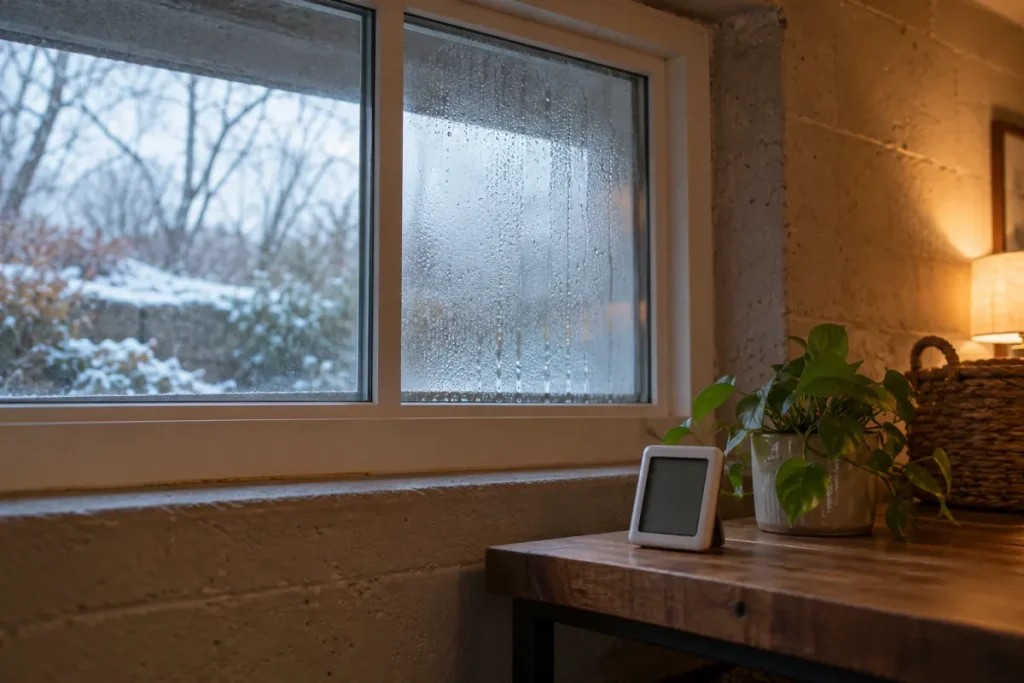
Condensation involves a surface cold enough for moisture in nearby air to collect on it. The National Weather Service explains relative humidity and dew point: relative humidity depends on temperature, while dew point is the temperature at which air becomes saturated when cooled. A room humidity reading does not tell you a wall’s surface temperature or identify where water came from.
In practice, reducing moisture in the air and repairing incoming water may require different actions. A lower humidity reading after running a dehumidifier cannot, by itself, demonstrate that a leak or seepage route has been repaired.
Record observations without turning them into a diagnosis
The prompts below are an editorial recording framework. They organize information to discuss with a professional; none is a test that confirms or rules out a cause.
| Observation | What it does not prove | Useful next detail |
|---|---|---|
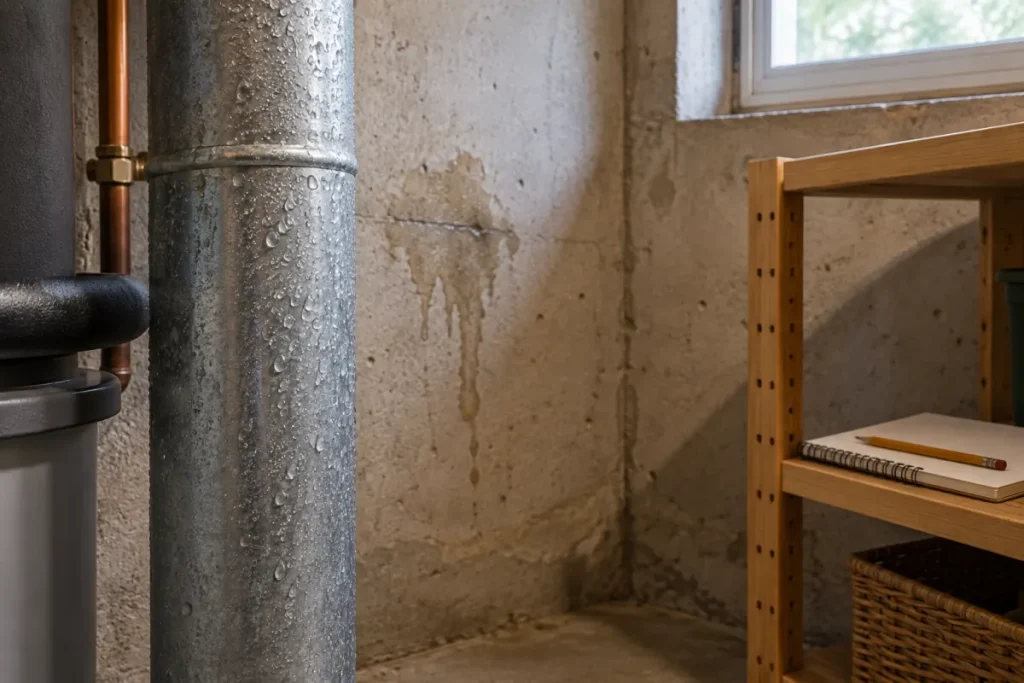
| Droplets on a pipe or another cool surface | That all nearby moisture is condensation | Which surface is wet; whether a joint is dripping; room temperature and humidity |
| Wetness discovered after rain | A particular foundation defect or entry route | Time discovered; recent weather; exact location; whether you actually saw water entering |
| Wetness near plumbing | That the nearest visible pipe caused it | Whether water was in use; any visible dripping; which areas were dry nearby |
| High room relative humidity | That a wet patch has no liquid-water source | Temperature, meter location, time, and the physical wetness pattern |
Make a short, useful first record
Use the blank moisture observation sheet. Fill in what you know and leave unknowns explicitly unknown.
- Identify the location. “Floor beside the north wall” is more useful than “basement wet.” Note the wet surface and visible extent.
- Separate discovery from onset. “Found at 7:30 a.m.” does not mean water first appeared then. Record the last dry observation only if you have one.
- Add context. Note recent rain, nearby water use, temperature, and relative humidity. Record the meter location so later readings are comparable.
- Photograph only from a safe position. Use an overview and a closer image if practical. Record the filenames privately; public photographs should exclude addresses and identifying details.
- Record the response. Note who you contacted and what changed afterward. A later dry patch is an observation, not proof that the cause is resolved.
A hypothetical note could read: “Wet patch at the north wall–floor joint, discovered at 7:30 a.m. after overnight rain. I did not see water entering. No earlier dry check available.” It provides context without claiming that rain caused a foundation leak.
Keep the room log and the wet-patch record together
Our basement humidity guide explains what room readings can tell you. The humidity log helps track them consistently. Add a reference to your wet-patch record when the two overlap, while keeping the observations distinct.
For example, a room may become drier while one location keeps getting wet. That is useful information to pass on, but it does not identify the source without further investigation. Avoid opening walls or changing drainage just to test a theory from this checklist.
Get help without waiting for a complete record
Visible ongoing water entry, unexplained recurring wetness, and suspected contaminated water deserve prompt attention. Avoid wet electrical equipment or entering an area where water creates an electrical hazard. Give the observations you already have to the appropriate landlord, repair professional, or emergency service for the situation.
EPA’s brief guide to mold and moisture emphasizes prompt action on leaks and water damage and calls for professional help when water may be contaminated. Its 24–48-hour drying guidance is a reason to act quickly, not a waiting period for diagnosis or a guarantee that every material can be saved.
The goal is a clearer account of the problem and timely action. You can improve the record as the situation develops; you do not need to identify the cause yourself before asking for help.