In brief
IEF stands for Integrated Energy Factor. It is a dehumidifier efficiency rating expressed in liters per kilowatt-hour, or L/kWh. It relates water removal to energy use under a defined test. A higher comparable IEF indicates greater rated efficiency; it does not directly tell you the appliance’s wattage, daily collection, or monthly electricity cost.
ENERGY STAR’s definition includes dehumidification and weighted standby or off-mode energy in the rating. That integration is one reason to keep IEF separate from an older Energy Factor figure.
Keep four specifications in separate columns
| Specification | Question it helps answer | What else you need |
|---|---|---|
| Removal capacity, pints per day | How much water was removed under the stated test? | Test basis and whether the capacity suits your conditions |
| IEF, L/kWh | What is the published efficiency on that test basis? | Comparable metric, product type, and supporting specification |
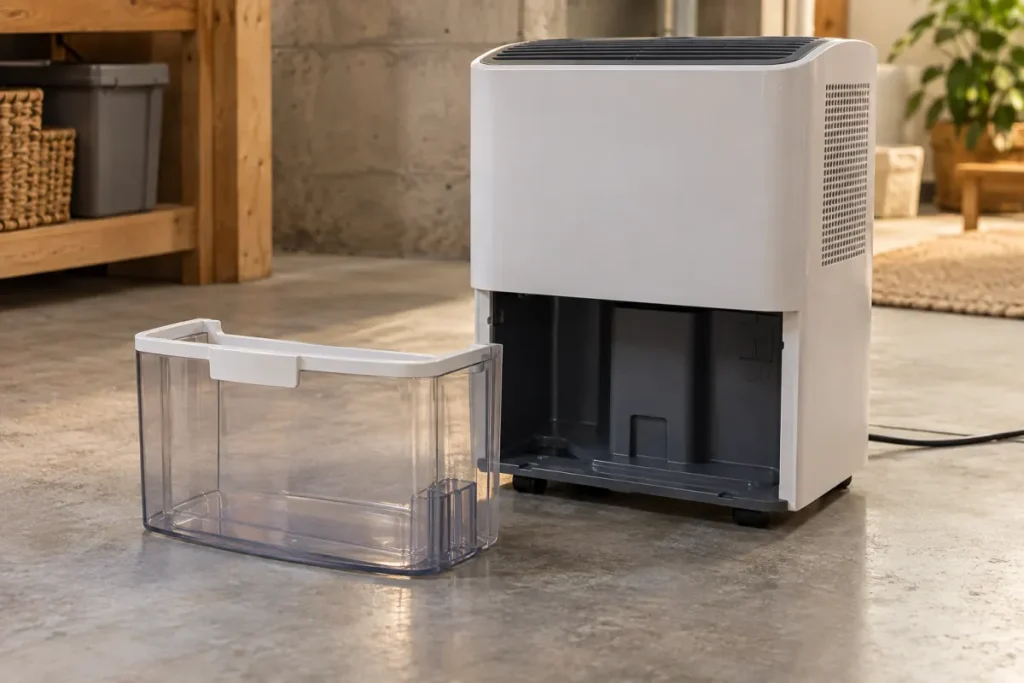
| Bucket volume, pints or liters | How much water can the collection container hold? | Usable volume, handling, shutoff, and drainage instructions |
| Power or measured energy, W or kWh | What inputs can support a running-cost estimate? | Operating time or measurement period and your electricity rate |
Our capacity and bucket guide explains the storage distinction. ENERGY STAR’s testing explanation separates capacity from efficiency and describes changes to test conditions. Do not treat a larger advertised capacity as automatic evidence of a more efficient product.
Check that a comparison has the same basis
Record the exact model, product type, metric name, unit, test reference where stated, and source date. A retailer’s listing may omit one of these. Mark it unknown until you can check the manufacturer or supporting documentation.
ENERGY STAR explains that IEF includes energy when the unit has cycled off, unlike the older EF metric. An EF number and an IEF number should not be ranked as if they describe an identical calculation. Likewise, do not assume that a portable appliance and a ducted whole-home system represent interchangeable installations simply because both list L/kWh.
Read a hypothetical pair without inventing a bill
Suppose two invented portable models have the same stated removal capacity and a confirmed comparable test basis. Model A lists an IEF of 1.8 L/kWh; model B lists 2.2 L/kWh. B has the higher rated efficiency on that basis. We have not tested either model; the values are an illustration.
The comparison does not tell you how many hours B will operate in your basement, whether its drainage arrangement fits, or which model has a more manageable bucket. It also does not establish a dollar saving. Keep those questions in separate columns rather than using the efficiency figure as a complete buying score.
If the test basis is missing for either listing, the next useful action is to obtain it. Precise arithmetic cannot repair an unsupported comparison.
Use electricity inputs for an electricity-cost estimate
A kilowatt-hour measures energy used over time, as the EIA explains. Our running-cost calculator uses average power with operating time, or measured kWh over a recorded period, alongside your rate.
Do not use the IEF value in the calculator’s watts field. Do not divide a guessed daily water volume by IEF and label the result a measured household bill. The rating belongs to its test, while actual operation and moisture conditions need their own evidence.
Make the specification useful in your shortlist
Use our basement buying checklist to establish which models meet the room, temperature, drainage, and access requirements first. Among suitable options with comparable ratings, IEF can inform the energy comparison.
Save the source link beside each number. A shortlist with a documented efficiency value and a clearly marked unknown is more useful than a confident ranking built from incompatible specifications.