In brief
A dehumidifier’s pints per day rating describes how much water it can remove under specified test conditions. Its bucket size describes how much collected water the container holds. They answer different questions: how much moisture can the unit remove, and how often might you need to empty it?
Compare both before buying. A large bucket does not establish a high removal capacity, and a high capacity rating does not tell you how long the bucket will last in your basement.
What each number measures
| Specification | What it describes | What it cannot establish alone |
|---|---|---|
| Water removal capacity, often in pints per day | Water removed over 24 hours under specified test conditions | Your room’s actual daily collection or whether a particular unit suits it |
| Bucket capacity, often in pints or liters | The manufacturer’s stated collection-container volume | Removal speed, energy efficiency, or how often you will empty it |
ENERGY STAR explains the 24-hour capacity rating and why test conditions matter. Its guidance describes a change from warmer to cooler test conditions that lowered reported capacities. When comparing listings, check the test basis and exact model rather than treating every advertised pint rating as directly comparable.
A larger bucket can mean less handling
Consider these invented specifications. They are an illustration, not products we have tested or recommendations.
| Illustrative unit | Removal rating | Bucket capacity |
|---|---|---|
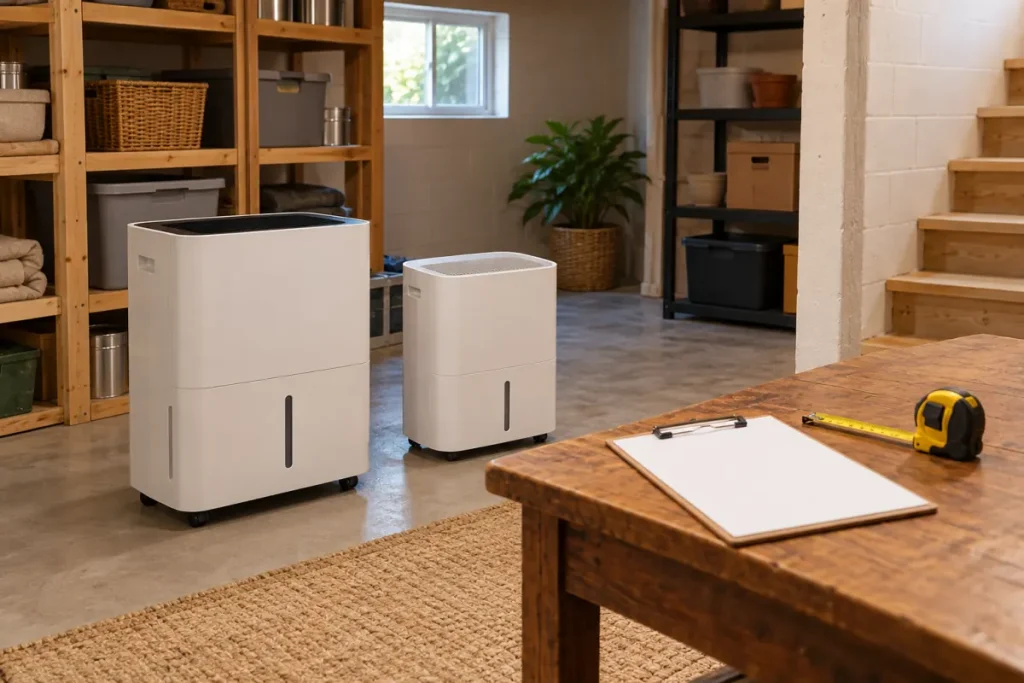
| A | 40 pints per day | 8 pints |
| B | 35 pints per day | 12 pints |
Assuming the same test basis, A has the higher removal rating; B has the larger bucket. Neither number settles the purchase. If carrying and emptying water is inconvenient, storage and drainage deserve attention. If the moisture load exceeds what a unit can handle, a larger bucket does not solve that mismatch.
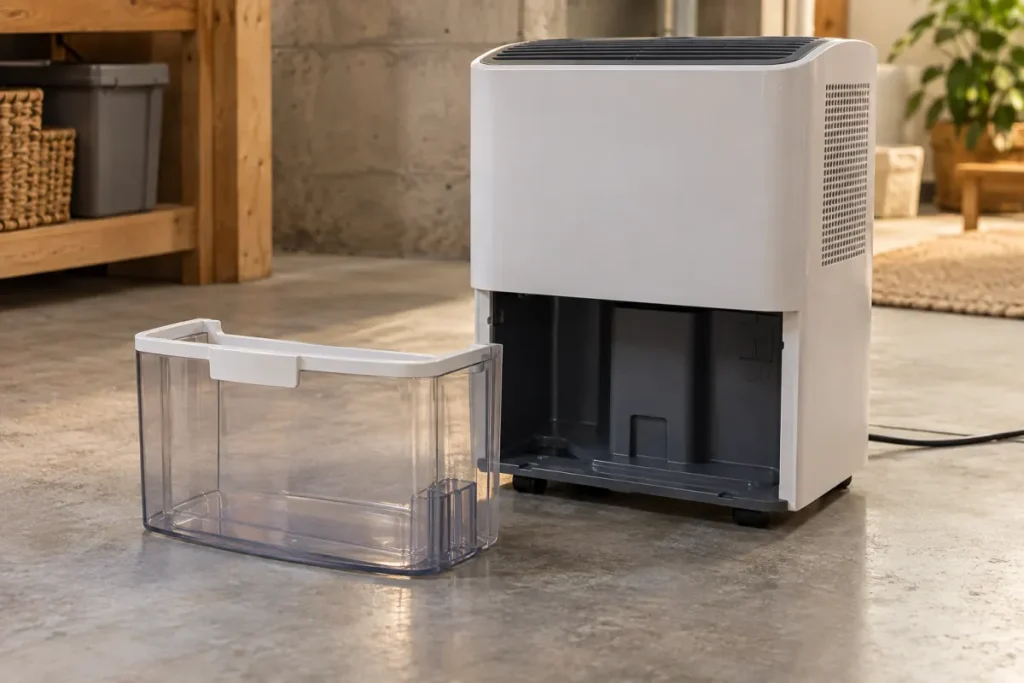
ENERGY STAR’s buying guidance says portable units typically switch off when the bucket is full. Check the exact model’s manual for shutoff behavior and its stated bucket capacity. Time spent waiting for someone to empty it can interrupt operation.
Why the rating does not predict an emptying schedule
Dividing bucket volume by the advertised daily rating produces a number, but it is not a dependable schedule for your home. The rating is a test result; collection in a room varies with conditions and how the unit operates. Room temperature, moisture supply, the chosen humidity setting, and operating time all matter.
For an existing unit, observe actual use: note the start time, starting bucket level, humidity setting, room temperature, and whether the unit stopped because the bucket was full. Record several ordinary operating periods in our basement humidity log. Do not deliberately leave a full unit unattended to establish a maximum interval.
Keep units consistent. A capacity in pints per day and a bucket volume in liters need converting before a numerical comparison. Record the original units first, including the pint definition if the listing is ambiguous.
Build a comparison you can check
Use the blank dehumidifier comparison sheet to keep each exact model and its evidence together. Work through these checks:
- Record removal capacity and test conditions. Use the manufacturer or manual; mark missing information as unknown.
- Record bucket capacity separately. Check the manual’s full-bucket instructions and whether its figure describes usable collection volume.
- Check the drainage arrangement. A hose outlet does not tell you whether your available drain works. Compare bucket, gravity drain, and pump arrangements against your layout.
- Check the operating temperature range. Match the manual’s limits to your room rather than assuming all portable units operate alike.
- Keep efficiency and electricity cost separate. ENERGY STAR describes Integrated Energy Factor in liters per kilowatt-hour. Use our IEF guide when comparing that specification. Our running-cost guide explains the inputs needed for a household estimate.
Which number should you prioritize?
Start with the room’s moisture problem and a suitable removal capacity, then decide how collection fits everyday use. ENERGY STAR’s sizing guidance considers both room size and moisture conditions. A bigger bucket can be useful where manual emptying is practical; a correctly arranged drain may reduce that work. Neither repairs a source of water entering the building.
The useful comparison is a set of documented specifications and installation requirements. Use our buying checklist to keep the room requirements alongside the specifications. Keep unknowns visible until the seller or manual resolves them, and avoid choosing solely by whichever number is largest on the listing.