In brief
To estimate the electricity cost of a dehumidifier, multiply its average power in kilowatts by operating hours and your electricity price per kilowatt-hour. For example, an assumed 400-watt average over eight hours a day at $0.20 per kWh costs $0.64 a day, or $19.20 over 30 identical days. Those inputs are an example; replace them with your own figures.
Calculate your dehumidifier cost
Calculate using your own numbers
The calculator has two routes. Estimated mode uses watts, hours per day, a number of days, and your price per kWh. Measured mode uses the total kWh recorded for a period and the length of that period. Neither route predicts weather or how long a future humidity problem will require the machine to run.
Estimate running cost
Use your own electricity price. The starting values are an example, not typical consumption or a national rate.
Electricity cost for the entered period
This estimates usage cost from your inputs. Fixed bill charges are excluded. Changing weather, settings, and operating states can change consumption.
The example values describe one calculation, not a typical dehumidifier or a national electricity rate. Clear the form or replace each value before using the result for a decision.
Understand the units
A watt measures power. A kilowatt-hour measures energy used over time. One kilowatt is 1,000 watts; running at one kilowatt for one hour uses one kilowatt-hour. EIA explanation of electricity measurement.
For a constant average power, the calculation is:
Daily energy in kWh = watts ÷ 1,000 × hours per day.
Period cost in dollars = daily kWh × number of days × dollars per kWh.
Find the rate that belongs in your calculation

Use the price per kWh that applies to your own electricity use. On some bills, the energy charge is one line among other usage-related charges; fixed account charges do not increase simply because this one appliance runs. If you are comparing scenarios, use the same definition of the rate for each one and note what it includes. The calculator accepts dollars per kWh: twenty cents is entered as 0.20, not 20.
If you do not know the precise marginal cost, run a range of reasonable rates from your own bill instead of presenting one uncertain value as exact. For the assumed 3.2 kWh/day example above, $0.15/kWh gives $0.48/day and $0.30/kWh gives $0.96/day. Those are arithmetic scenarios, not claims about typical US electricity prices. The EIA explains the energy units used by bills and meters.
Use power and time that belong together
The critical assumption is that your watts represent the average power over the hours entered. A dehumidifier can cycle between operating states, so a rated figure multiplied by every hour it is plugged in may give a different result from actual consumption. ENERGY STAR's testing documentation distinguishes water-removal capacity from energy efficiency and includes energy used when the unit cycles off in its Integrated Energy Factor. ENERGY STAR testing and capacity.
For estimated mode, use average power for the period you describe. If you know only a rated wattage, label the result as a scenario at that wattage, not a measured bill. Counting compressor runtime alone may omit fan or standby use. A suitable energy meter can record total kWh over several representative days; note the room conditions and setting because a wetter month could differ. Use any meter only within its rating and according to its instructions and the appliance manual.
Compare three clearly stated scenarios
These are arithmetic examples using the same assumed $0.20 per kWh and 30-day period.
| Assumed average power | Hours per day | Daily energy | Cost over 30 days |
|---|---|---|---|
| 300 W | 6 | 1.8 kWh | $10.80 |
| 400 W | 8 | 3.2 kWh | $19.20 |
| 600 W | 12 | 7.2 kWh | $43.20 |
The table does not rank devices. The examples have different operating hours and may represent different conditions. A machine that costs less in this calculation is useful only if it also achieves the moisture-control result you need.
Calculate dehumidifier cost from measured kWh
Suppose a suitable meter records 12 kWh over four days. At an assumed $0.20 per kWh, the recorded period costs $2.40. Dividing by four gives 3 kWh and $0.60 per observed day. The calculator also shows a 30-day projection of $18.00 if the same daily pattern repeats.
That projection carries an explicit assumption. It is not a prediction of next month's bill. Rain, temperature, room use, settings, and changes to the moisture source may alter the pattern. Keep the reading dates and the equipment settings with your measurement so you can recognize what period the result actually describes.
Compare operation and result together
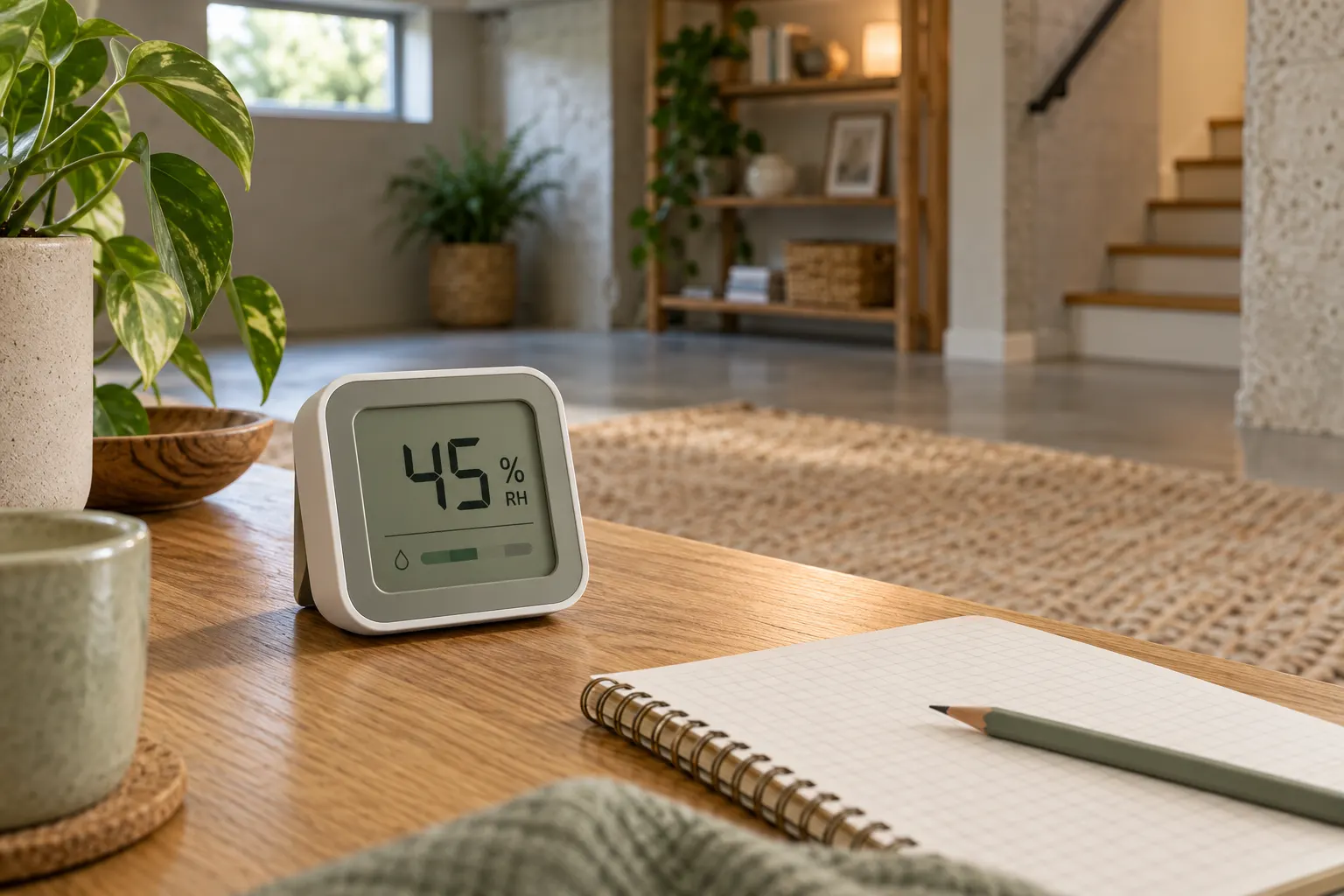
A low cost is not a good outcome if the basement remains damp. Pair the energy record with a humidity log and note whether visible moisture conditions changed. The basement humidity guide explains how to read those observations. If you alter a setting, record the date and allow enough comparable observation to understand the result. A cost estimate tells you what the electricity might cost; it cannot tell you whether a leak has been addressed.
When comparing two appliances, do not rank them by this calculator alone. Their capacities and published efficiency values may describe different test conditions or use patterns. ENERGY STAR’s buying guidance describes capacity, and its efficiency criteria define Integrated Energy Factor in liters removed per kWh under a test. Use those specifications as part of a larger decision about the space, drainage arrangement and maintenance, not as a substitute for your room observations or a prediction of your dollar cost.
Save a calculation someone else can reproduce
- Input: watts or measured kWh, duration, days and dollars per kWh.
- Condition: room, setting and whether the bucket or drain interrupted operation.
- Result: daily and period cost, clearly labeled estimate or observation.
- Limit: what would make the next period different, such as rain, temperature or a changed schedule.
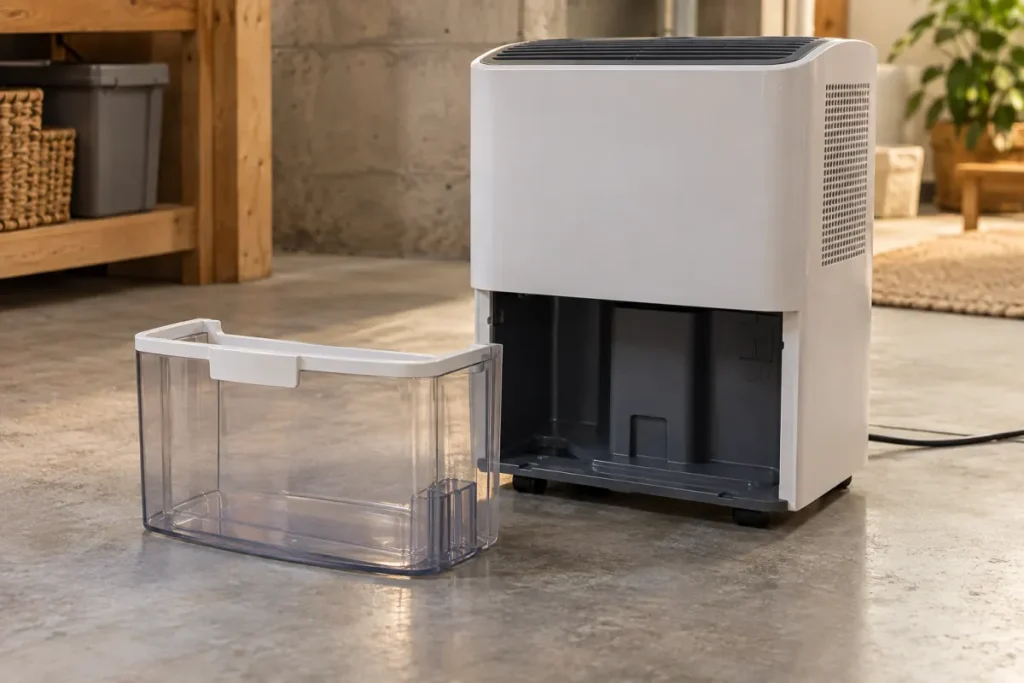
If the bucket regularly stops the appliance, the drainage options guide helps you compare a manual routine with a supported continuous route. That may be a more useful next decision than trying to shave pennies from an arithmetic estimate.