In brief
Before comparing basement dehumidifiers, write down the conditions the appliance must work in and how you will handle the collected water. Then check exact models against those requirements. This checklist helps you build a defensible shortlist without relying on a “best” label or the largest number in a listing.
We have not tested or ranked products for this guide. The room brief, comparison process, and printable worksheet are our editorial planning tools.
1. Describe the room and the problem
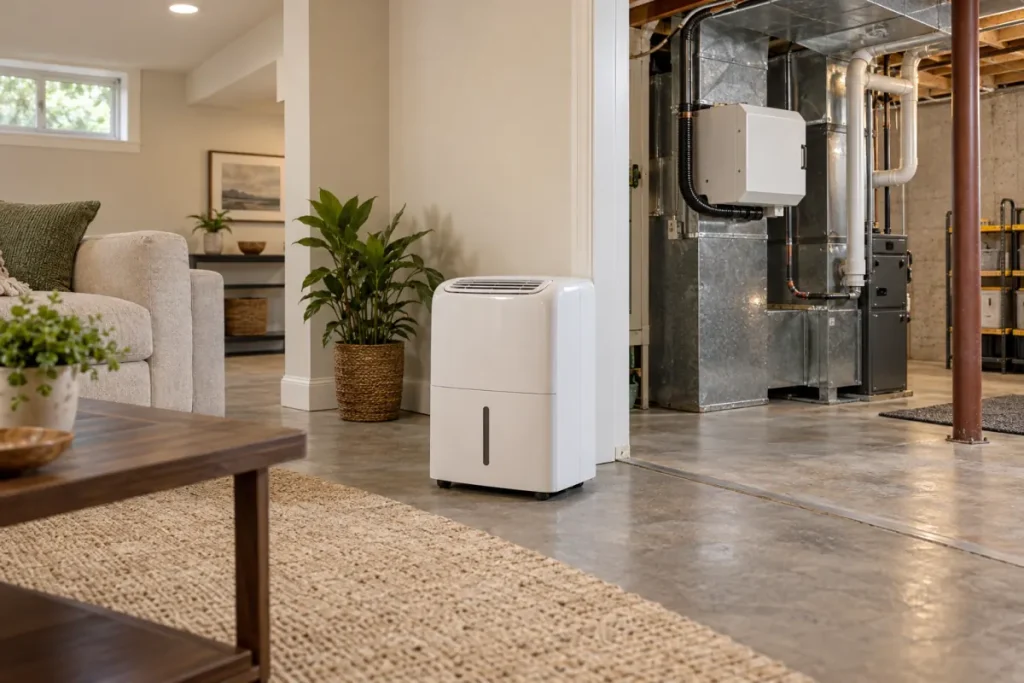
Record the area to manage, whether doors separate it from other areas, observed humidity and temperature, and any visible wetness. Use a humidity log if you need a baseline. You can keep building the shortlist while gathering observations, but label missing conditions as unknown.
ENERGY STAR’s buying guidance considers both space size and moisture conditions when discussing removal capacity. Check the exact model’s sizing information; an advertised square-foot coverage figure alone is an incomplete room assessment. If water is actively entering, address that source rather than treating an appliance purchase as the repair.
2. Confirm that the model can operate in those conditions
Find the operating temperature range in the manual and compare it with your recorded conditions, including colder periods when the appliance will be used. ENERGY STAR identifies operating temperature as a buying consideration. “Basement suitable” in a listing is less useful than a documented operating range.
For an uncertain or complex space, ask the manufacturer or an appropriate installer about sizing and suitability. A portable unit for one area and a ducted whole-home system are different installation decisions. Do not turn a checklist into a universal sizing formula.
3. Choose a water-handling arrangement you can maintain
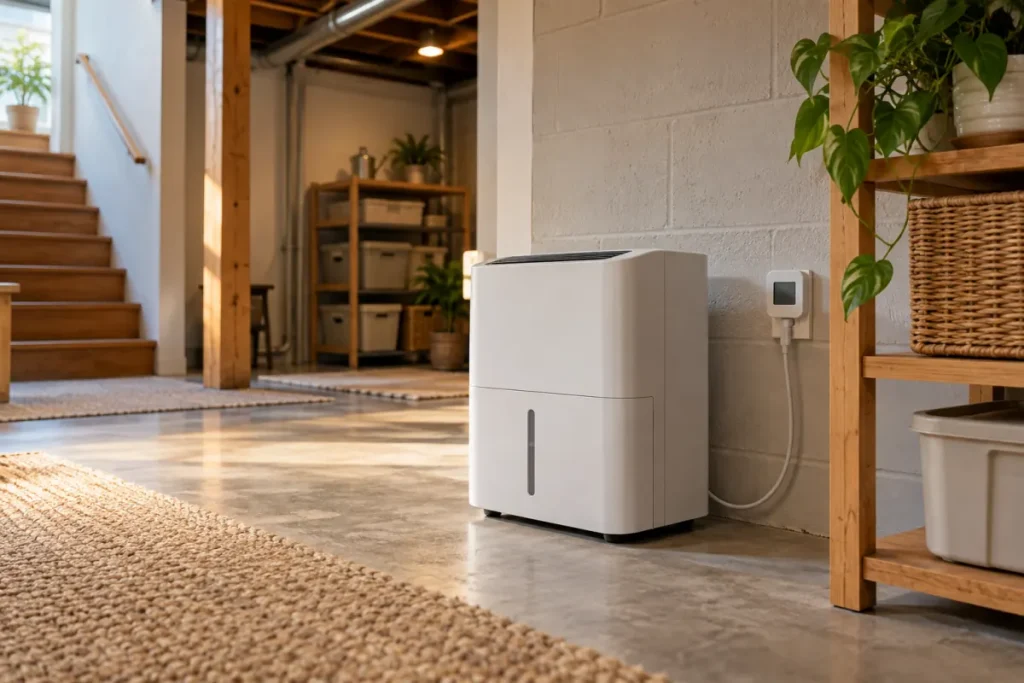
Will someone empty the bucket reliably? Is there a suitable lower destination for a supported gravity route? Does the route need to rise, making a compatible pump worth investigating? Start with our drainage comparison and then check the exact model’s connection, hose, lift, and activation instructions.
Price any required accessories as part of that arrangement. A “continuous drain” feature does not establish that the available destination or tubing is suitable. Keep an unresolved route as an open question before purchase.
4. Check access before comparing convenience features
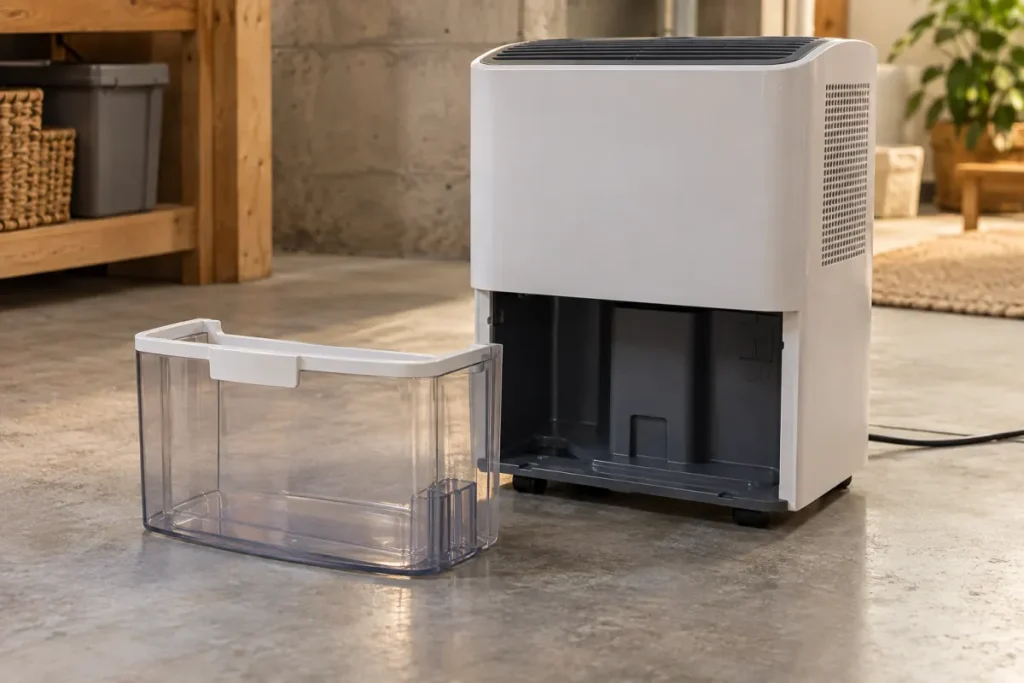
Record the model’s dimensions and required clearances. Consider the additional room needed to remove its bucket or filter, operate the controls, and inspect the drain. A unit can fit inside a gap while remaining impractical to use there.
Check the user-maintenance section of the manual. Can you reach the parts it expects you to clean? Are replacement user parts available when needed? Use our maintenance record to keep the instructions with the equipment after purchase.
5. Compare specifications on a documented basis
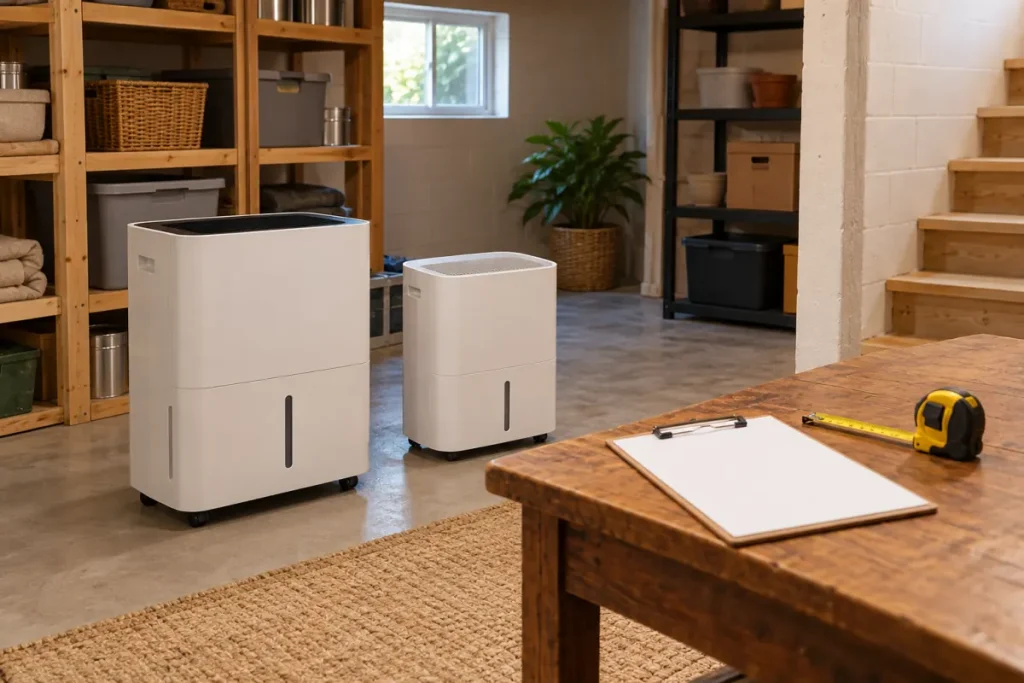
Keep removal capacity and bucket size separate. Record their units and source. Add the efficiency metric exactly as listed, and use our IEF explanation to check whether the values are comparable. Missing evidence belongs in an “unknown” field, not an assumed score.
For noise information, retain any measurement conditions supplied with the figure. Ask about fan modes and the intended placement when the room is used for work or relaxation. We do not supply a measured sound comparison or infer quietness from a product name.
6. Use a short comparison that exposes the next question
| Requirement | Evidence to retain | Decision if missing or incompatible |
|---|---|---|
| Room and temperature suitability | Your room brief and the model’s manual or sizing guidance | Ask about suitability; do not assume coverage |
| Drainage and access | Supported route, required accessories, and clearance instructions | Resolve the route or remove the unsuitable model |
| Comparable performance | Removal capacity, bucket volume, efficiency metric, and test basis | Keep unknowns visible before ranking |
| Purchase and ownership cost | Dated price, accessories, delivery, return terms, and a labeled energy scenario | Check the seller’s current terms; do not invent a total |
Use the printable buying worksheet for a room brief and two-model comparison. It starts blank and has no automatic recommendation. The existing comparison spreadsheet template is another way to retain the model specifications.
7. Decide which uncertainties matter before paying
First remove models with a documented mismatch to an essential requirement. Next resolve questions that could change the purchase, such as an unsupported drain route or an unknown operating limit. Among the remaining suitable models, compare price, documented efficiency, handling, and support arrangements.
Use the running-cost calculator for clearly labeled electricity scenarios, not a guaranteed ownership cost. Save the exact model, source links, dated quote, and one sentence explaining the choice. That record gives you a useful starting point for setup and for checking the result after purchase.